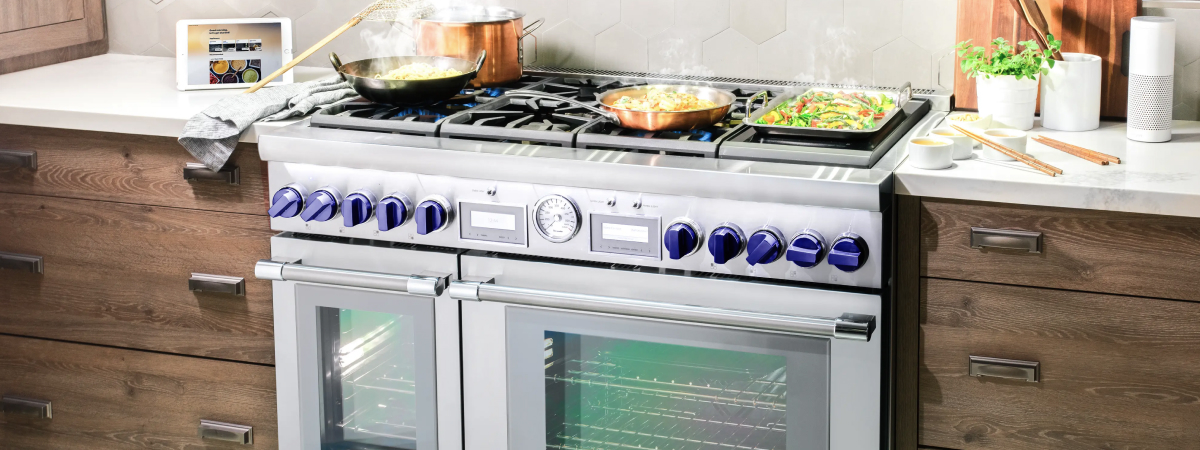
You turn the knob. Click. Click. Click. The burner doesn’t catch. You turn it off, try again — same thing. Meanwhile dinner is waiting and the clicking just keeps going.
Here’s the good news: on a Thermador range, that clicking almost never means the range is dying. It usually means something small is in the way of a spark. Most of the time you can sort it out yourself in ten minutes. Sometimes you can’t — and we’ll be straight with you about which is which.
Burner still won’t light? Call 844-975-6696 or book a visit.
Quick guide: why it’s clicking but not lighting
| What you’re seeing | Most likely cause | Can you fix it yourself? |
|---|---|---|
| Clicks after cleaning the cooktop | Wet igniter | Yes — let it dry fully |
| One burner clicks, won’t light | Crooked burner cap | Yes — reseat the cap |
| Slow to light, then catches | Blocked burner ports | Yes — clear the ports |
| Clicks with the knob OFF | Spark module or wiring | No — call a technician |
| You smell gas | Unburned gas | Stop — ventilate and call the utility |
First, what that clicking actually is
The clicking is the igniter doing its job. It’s a small ceramic tip next to the burner that throws a spark, over and over, until it detects a flame. When gas lights, the clicking stops.
So if it keeps clicking, one of two things is true:
- The spark isn’t happening — the igniter is dirty, wet, or worn out.
- The gas isn’t arriving — the burner ports are blocked, or the cap is sitting crooked.
That’s it. Everything below is just figuring out which one you’ve got.
Did you just clean the cooktop? That’s probably your answer
This is the single most common call we get, and it catches people off guard because they did nothing wrong — they cleaned.
Water, cleaning spray, or even steam from a boiling pot can leave moisture on the igniter. A damp igniter can’t light gas. It’ll spark and spark and spark, and nothing happens.
What to do: turn the burner off. Let everything dry — properly dry, an hour or more, not five minutes. If you’re impatient, a hair dryer on cool helps. Then try again. In most cases, that’s the whole fix.
If it’s dry and still clicking: look at the burner cap
The burner cap has to sit flat and centered. Nudge it a millimeter off — while wiping the cooktop, say — and the gas comes out in the wrong place, away from the spark.
Lift the cap off (when cold), set it back down, and feel it settle into place. It should sit level, not rock. This takes four seconds and fixes a surprising number of “broken” burners.
Still clicking? Now check the ports
Around the rim of the burner are small holes — the ports. Gas comes out of those. Boil-overs, grease, and crumbs plug them up, and blocked ports mean gas can’t reach the spark.
With the burner cold and off: gently clear the holes with a toothpick or a straightened paper clip. Not a needle, not a drill bit — you don’t want to widen them. Wipe the igniter tip with a cotton swab, barely damp, then let it dry completely.
If one burner works and another doesn’t, that’s a strong hint it’s a blocked port or a bad igniter on that one burner — not a problem with the range as a whole.
Stop here and call someone if any of this is true
We’d rather lose a service call than have you get hurt. Turn the burner off and step away if:
- You smell gas. Don’t touch switches, don’t light anything. Ventilate, leave, and call your gas utility first — before you call us.
- It clicks with the knob OFF. That points to the spark module or wiring, not the burner. It won’t fix itself.
- Every burner clicks and none light. One burner is a burner problem. All of them is usually the module or the gas supply.
- The flame lights, then dies a few seconds after you release the knob. That’s a different fault entirely — the flame sensor or safety valve.
Anything involving the gas line, the valve, or opening up the range is not a DIY job. Not because it’s difficult — because being wrong is expensive in ways that don’t involve money.
Questions we get asked all the time
Can I keep cooking on the other burners?
If one burner clicks and won’t light, and you don’t smell gas, the other burners are generally fine to use. But if the clicking continues even with everything off, stop and call. That’s electrical, not cooking.
Why does it click for a while and then light?
A slow light usually means a weak spark or a partially blocked port — gas is getting there, just not fast enough. It’s an early warning. Clean it now and you’ll probably avoid the day it stops lighting at all.
Is it safe to just light it with a match?
Please don’t make a habit of it. If gas is flowing but not igniting, you’ve got unburned gas collecting while you fumble for a match. Once, in a pinch, carefully — fine. As a routine, it’s a bad trade.
How much does an igniter replacement cost?
It depends on the model and which part actually failed — the igniter, the spark module, or the wiring. We diagnose first and give you a written price before anything gets replaced. No surprises at the end.
My range is 15 years old. Worth fixing?
Usually, yes. Thermador ranges are built to be serviced, and an igniter or a spark module is a small part of what the range is worth. We’ll tell you honestly if a repair doesn’t make sense — we’d rather keep you as a customer than sell you one bad job.
If it’s still clicking, we’ll come look at it
You’ve dried it, reseated the cap, cleared the ports — and it still won’t light. At that point it’s the igniter, the spark module, or the gas valve, and all three want a technician with a meter, not a toothpick.
We’re Thermador specialists, not generalists. We arrive with the common parts already on the truck, so most of these get fixed in one visit. You get a written estimate before we touch anything, and a warranty on the work.
Call 844-975-6696 or book a visit online. Same-day slots are usually available in New York, Los Angeles, Chicago, San Francisco, Houston, and Miami.
Related: Thermador range repair · cooktop repair · Thermador error codes