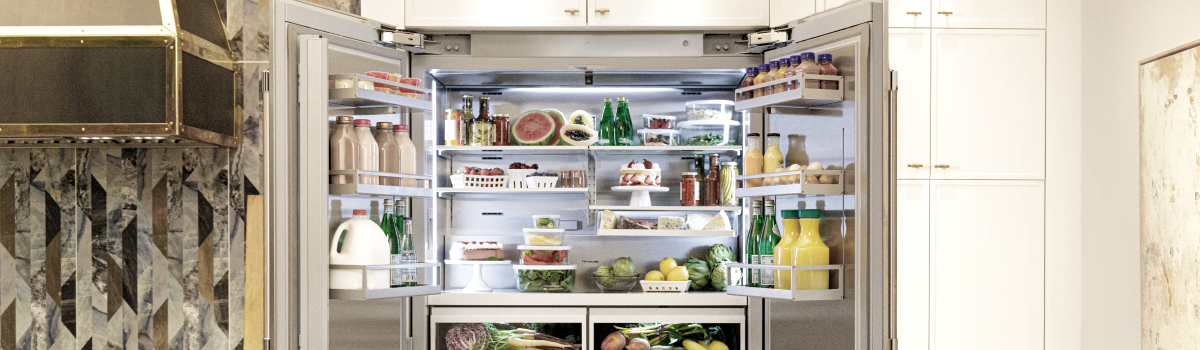
The fridge seems cold enough, but the lettuce wilts in two days, the berries turn overnight, and the milk sours before its date. Food spoiling early has two very different explanations: either the fridge isn’t holding the temperature it should, or it is — and the problem is where and how things are stored. This guide sorts out which, then shows you how to make food last as long as it should.
Losing groceries every week? Call 844-975-6696 or book a visit.
First: is it the fridge, or the storage?
Half of “food spoiling” problems are actually a temperature fault, and half are storage. Match what you’re seeing to the right guide:
| What you’re seeing | What it really is | Where to go |
|---|---|---|
| Fridge warm all over, not getting cold | A cooling fault | Fridge not cooling |
| Cold one day, warm the next | Temperature swinging | Temperature keeps changing |
| Cools, but never reaches the setting | Can’t hold temperature | Won’t hold its temperature |
| Fridge is genuinely cold, food still spoils | Storage — placement & humidity | You’re in the right place — read on |
If a thermometer confirms the fridge is holding around 37 °F and food still spoils fast, the fix isn’t a repair — it’s how and where you’re storing things. That’s where most people lose groceries without realising it.
Where’s the coldest — and warmest — part of your fridge?
A fridge isn’t one even temperature. Cold air enters near the back and top, so those areas run coldest, while the door — hit by warm room air every time it opens — is always the warmest spot. Knowing the map changes where things should live:
- The door is the warmest zone. It’s the worst place for anything perishable — yet it’s where most people keep the milk. That’s why milk in the door often sours days early. Move milk, eggs, and anything you want to keep to an inside shelf, and save the door for condiments and juice that don’t mind the swing.
- The bottom shelf is the coldest. It’s the best place for raw meat and fish — both because it keeps them coldest and because, if a package leaks, it can’t drip onto food below. Keep them in a tray on the bottom shelf, not up top.
- The back and top run cold too. Great for leftovers and dairy you want to last; just keep items off the vents so you don’t block airflow or freeze what’s pressed against the back wall.
The crisper drawers: humidity is the secret
The crisper drawers have a humidity slider for a reason, and getting it right roughly doubles how long produce lasts. The rule is simple once you know it:
- High humidity (vent closed) — for vegetables. Leafy greens, herbs, carrots, broccoli. These wilt when they lose moisture, so trapping humidity keeps them crisp.
- Low humidity (vent open) — for fruit. Apples, pears, and most fruit give off ethylene gas as they ripen; letting it escape stops them over-ripening and rotting each other. Open the vent to let that gas and excess moisture out.
Set both drawers wrong — everything on high humidity — and fruit rots while moisture pools; set everything low and greens go limp. Matching the drawer to what’s in it is the single biggest storage win for produce.
When food freezes instead of spoiling
The other side of “spoiling” is food that freezes where it shouldn’t — lettuce going glassy, eggs cracking, milk with ice in it. Where this happens tells you whether it’s placement or a fault:
- Only items at the very back or against the wall freeze. That’s normal cold-spot behaviour, not a fault. The back wall is where cold air enters and it runs coldest — pull delicate produce forward a few inches, off the wall and away from the vents, and it stops.
- Food all over the fridge freezes, or ice forms on shelves. That’s the fridge running too cold — a temperature fault, not placement. It belongs with the temperature guides, not this one.
How long food actually keeps
Sometimes food isn’t spoiling early at all — it’s just reaching the end of its real fridge life. The storage windows below follow USDA food-safety guidance for a fridge held at or below 40 °F:
- Raw poultry and ground meat: 1–2 days.
- Raw steaks, chops, and roasts: 3–5 days.
- Cooked leftovers: 3–4 days.
- Milk, opened: about 5–7 days past opening, kept off the door.
- Most cut or leafy produce: 3–7 days in the right drawer.
If your food is lasting far short of these even with correct storage and a fridge that measures cold, the fridge itself is the suspect — jump back to the router table above.
Step-by-step: what to check yourself
- Confirm the fridge is actually cold. Do this: stand a thermometer in a glass of water overnight; aim for about 37 °F. What it means: if it reads warm, this is a temperature fault, not storage — follow the router table. If it reads right, the fixes below are yours.
- Move perishables off the door. Do this: shift milk, eggs, and meat to inside and bottom shelves. What it means: the door’s warmth is the hidden reason a lot of “early spoiling” happens — this one change often fixes it.
- Set the crisper humidity to match. Do this: vegetables in the high-humidity drawer, fruit in the low. What it means: matching the drawer roughly doubles how long produce lasts.
- Don’t overpack. Do this: leave gaps around the vents. What it means: crammed shelves block airflow and create warm pockets where food spoils while the rest stays cold.
- Check the door seal. Do this: dollar-bill the door at several points. What it means: a leaky seal lets warm air in and shortens the life of everything, especially near the door — a clean-or-replace fix.
When it’s the fridge, not the storage
If a thermometer shows the fridge is genuinely warm despite a correct display, or the temperature won’t hold, the cause is a sensor, seal, or cooling fault — and no amount of rearranging fixes that. Those are covered in depth in the guides linked above, and they’re where a technician comes in: the sensor and control board need meter testing, and a sealed-system issue needs certified handling. Book Thermador refrigerator repair so you stop throwing money in the bin every grocery run. You get a written estimate before any work, and the common parts ride on the truck for a one-visit fix.
How to keep food fresh longer
- Hold the fridge near 37 °F and check it now and then with a thermometer, not just the display.
- Keep milk, eggs, and meat off the door; put raw meat on the bottom shelf.
- Match crisper humidity to what you’re storing — high for veg, low for fruit.
- Don’t block the vents, and keep the door seal clean and intact.
Frequently asked questions
Q: Where is the coldest part of the refrigerator?
A: The bottom shelf and the area near the back and top vents run coldest, since that’s where cold air enters. The door is always the warmest. Store raw meat on the bottom shelf and keep perishables off the door.
Q: Why does milk spoil fast in the door?
A: The door is the warmest zone — it takes warm room air every time the fridge opens. Milk kept there sits warmer than the rest and sours days early. Move it to an inside shelf and it lasts noticeably longer.
Q: What humidity setting should the crisper drawers be on?
A: High humidity (vent closed) for vegetables and leafy greens, low humidity (vent open) for fruit. Fruit gives off ethylene gas that speeds ripening, so letting it escape stops fruit rotting; trapping moisture keeps greens crisp.
Q: My fridge feels cold — why does my food still spoil?
A: “Feels cold” and “cold enough” aren’t the same. Measure it with a thermometer: if it’s above 40 °F it’s a temperature fault; if it’s holding 37 °F, the issue is storage — placement, humidity, or an overpacked fridge blocking airflow.
Stop losing groceries
If storage isn’t the answer and the fridge is truly running warm, we’ll find out why. We handle Thermador refrigerator repair with a written estimate before any work starts.
Call 844-975-6696 or book online. Same-day service is usually available in New York, Los Angeles, Chicago, San Francisco, Houston, and Miami.